Showing posts with label Most Rare Animals in the World. Show all posts

Dwarf Blue Sheep


The Dwarf Blue Sheep or Dwarf Bharal Pseudois schaeferi is an endangered species of caprid found in China Proper and Tibet. It inhabits low, arid, grassy slopes of the upper Yangtze gorge in Batang County of the Sichuan Province, and a small part of the Tibet Autonomous Region, where it is known by the local name Rong-na.

Originally given subspecific status to the Bharal (Pseudois nauyar), morphological research conducted in the 1970s led it to be considered a distinct species. However recent molecular analysis has shown the difference between the two species is slight, and suggests it should be treated as a subspecies of the Bharal.

The Dwarf Blue Sheep differs from the Bharal primarily in size, with adult males weighing around 35kg, half as much as the Bharal. Less sexual dimorphism occurs in this species, and females of the two species are very similar. Its coat is a steely grey with a silvery sheen, with darker general colouration than the Bharal, and the horns of the male are smaller, thinner and more upright, with no inward curl.

In 2000 there were estimated just 200 individuals of Dwarf Blue Sheep alive. The species is hunted, and in their limited range cannot escape from humans and livestock. Although a reserve of 142.4 square km was set up around Zhubalong in 1995, human activities continue to go on there.

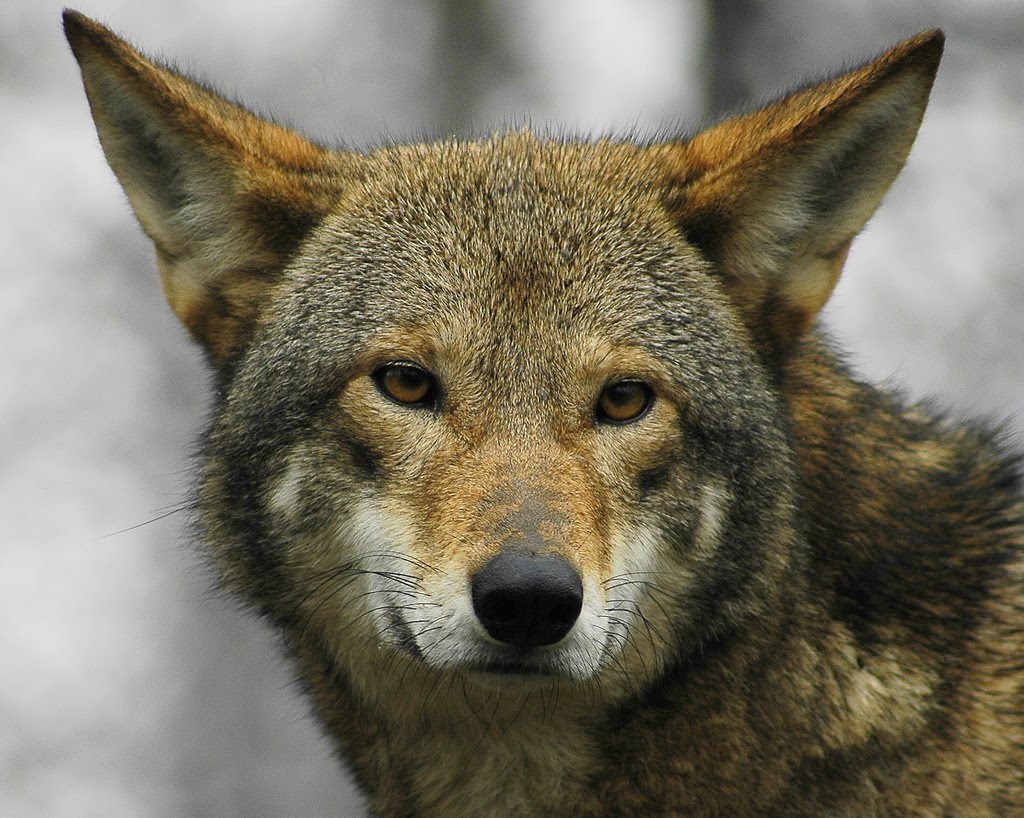
Red Wolf


Aggressive predator control programs, hunting and agriculturalization have combined to bring the red wolf near to extinction, because it was thought to be a threat to livestock. It is now considered rare.

It is thought that its original distribution included much of eastern North America, where Red Wolves were found from New York in the east, Florida in the south, and Texas in the south-west. Records of bounty payments to Wappinger Indians in New York in the middle 1700s confirm its range at least that far north; it's possible that it could have extended as far as extreme eastern Canada. There are thought to be about 300 red wolves remaining in the world, with 207 of those in captivity. For decades, the Red Wolf has been indistinguishable genetically from either the Gray Wolf or the Coyote. The Red Wolf breeds with both species and may again be in peril as contact with other species in the wild resumes.

In 1987 approximately 100 were reintroduced into the wild as the first island propagation project in the Alligator River National Wildlife Refuge off the coast of North Carolina. In 1989 the second island propagation project initiated with release of a population on Horn Island off the Mississippi coast. This population was moved in 1998 because of a likelihood of encounters with humans. The third island propagation project introduced a population on St. Vincent Island, Florida offshore between Cape San Blas and Apalachicola, Florida in 1990, and in 1997 the fourth island propagation program introduced a population to Cape St. George Island, Florida south of Apalachicola, Florida. In 1991 two pairs were reintroduced into the Great Smoky Mountains National Park, where the last known wolf was killed in 1905. Despite some early success, the wolves were relocated to North Carolina in 1998, ending the effort to reintroduce the species to the Park. Historical habitats included forests, swamps and coastal prairies, where it was an apex predator.


Red Wolf


The Red Wolf (Canis rufus) is a North American canid and once roamed throughout the Southeastern United States and is a glacial period survivor of the Late Pleistocene epoch. Its natural range extends from Texas to Florida. A population is being reintroduced to North Carolina.Scientists suggest that Red Wolf populations were extirpated from the wild and are now highly endangered.

Origin

The origins of the Red Wolf line are set at 1-2 Ma with a branching from a common ancestor, also known as the Canis rufus, which appeared about 4.9 Ma. The current Red Wolf shared this ancestor with the Gray Wolf, the Eastern Wolf, and the Coyote. One branch remained in North America, while other branch migrated to Eurasia, giving rise to the Gray Wolf. Between 150,000—300,000 years ago, the North American branch evolved into the eastern wolf and the Coyote. Wilson et al. (2000) concluded that the Eastern Wolf and Red Wolf should be considered as sister taxa and recognized as distinct species from other North American canids. However, these conclusions have been widely disputed (for example see Koblmuller et al. (2009) ), and the canonical listing of mammal species lists them both as subspecies of the Gray Wolf.

Iberian Lynx


While the Eurasian Lynx bears rather pallid markings, the Iberian lynx has distinctive, leopard-like spots with a coat that is often light grey or various shades of light brownish-yellow. Some western populations were spotless, although these have recently become extinct.

The head and body length is 85–110 cm, with the short tail an additional 12–30 cm; the shoulder height is 60–70 cm. The male is larger than the female, with the average weight of males 12.9 kg and a maximum of 26.8 kg, compared to 9.4 kg for females; this about half the size of the Eurasian lynx.

The Iberian Lynx has four sets of whiskers: two groups on the ears and two on the chin. It uses these to sense its prey.


Iberian Lynx


The Iberian lynx (Lynx pardinus), sometimes referred to as the Spanish lynx, is a critically endangered species native to the Iberian Peninsula in Southern Europe. It is the most endangered cat species in the world.According to the conservation group SOS Lynx, if this species died out, it would be the first feline
extinction since the Smilodon 10,000 years ago.The species used to be classified as a subspecies of the Eurasian Lynx (Lynx lynx), but is now considered a separate species. Both species occurred together in central Europe in the Pleistocene epoch, being separated by habitat choice. The Iberian lynx is believed to have evolved from Lynx issiodorensis.

Tamaraw (Dwarf Water Buffalo)


The Tamaraw (Bubalus mindorensis) or Mindoro Dwarf Buffalo is a small hoofed mammal belonging to the family Bovidae. It is endemic to the island of Mindoro in the Philippines and is the only endemic Philippine bovine. It is believed, however, to have once also thrived on the greater island of Luzon. The tamaraw was originally found all over Mindoro, from sea level up to the mountains (2000 meters above sea level), but because of human habitation, hunting, and logging, it is now restricted to only a few remote grassy plains and is now an endangered species.

Contrary to common belief and past classification, the tamaraw is not a subspecies of the local carabao, which is only slightly larger, or the common water buffalo. In contrast to the carabao, it has a number of distinguishing characteristics: it is slightly hairier, has light markings on its face, is not gregarious, and has shorter horns that are somewhat V-shaped. It is the largest native terrestrial mammal in the country.


Northern Hairy-nosed Wombat


The Northern Hairy-nosed Wombat (Lasiorhinus krefftii), also known as the Yaminon, is one of three species of wombats. It was found across New South Wales, Victoria and Queensland as recently as 100 years ago, but is now restricted to a 3 km² range within the 32 km² Epping Forest National Park in Queensland. It is one of the rarest large mammals in the world and is critically endangered. It is slightly larger than the Common Wombat and able to breed somewhat faster (two young every three years). Its habitat has become infested with African buffel grass, which out-competes the native grasses the Yaminon prefers to feed on. A two metre-high predator-proof fence was constructed around 25 km² of the park in 2000, but captive breeding and translocation programs have been abandoned for the time being because the population in the sole remaining Yaminon colony is considered too small to allow the safe removal of the 15 or 20 individuals needed to start a new wild colony, and because more than a decade of captive breeding research with Common and Southern Hairy-nosed Wombats has produced only a handful of successful births.

The Northern Hairy-nosed Wombat is listed as "endangered" by the Australian Species Profile and Threats Database (SPRAT), and "critically endangered" by the IUCN.


Hispid Hare


The Hispid Hare, Caprolagus hispidus, is a leporid native to the foothills of the Himalaya. This hare was formerly widely distributed but its habitat is much reduced and degraded by deforestation, cultivation, and human settlement, and now it is confined to isolated regions in Uttar Pradesh, Bihar, West Bengal and Assam. It is one of the world's rarest mammals.

Also Called as "Bristly Rabbit” that can be found in Himalaya Nepal, Bengal and Assam, now only left 110 hispid hare.. in this world

Javan Rhinoceros


The Javan Rhinoceros (Sunda Rhinoceros to be more precise) or Lesser One-horned Rhinoceros (Rhinoceros sondaicus) is a member of the family Rhinocerotidae and one of five extant rhinoceroses. It belongs to the same genus as the Indian Rhinoceros, and has similar mosaicked skin which resembles armor, but at 3.1–3.2 m (10–10.5 feet) in length and 1.4–1.7 m (4.6–5.8 ft) in height, it is smaller than the Indian Rhinoceros, and is closer in size to the Black Rhinoceros. Its horn is usually less than 25 cm (10 inches), smaller than those of the other rhino species.

Once the most widespread of Asian rhinoceroses, the Javan Rhinoceros ranged from the islands of Indonesia, throughout Southeast Asia, and into India and China. The species is now critically endangered, with only two known populations in the wild, and none in zoos. It is possibly the rarest large mammal on earth.[5] A population of at least 40–50 live in Ujung Kulon National Park on the island of Java in Indonesia and a small population, estimated in 2007 to be no more than eight, survives in Cat Tien National Park in Vietnam. The decline of the Javan Rhinoceros is attributed to poaching, primarily for their horns, which are highly valued in traditional Chinese medicine, fetching as much as $30,000 per kilogram on the black market.[5] Loss of habitat, especially as the result of wars, such as the Vietnam War, in Southeast Asia, has also contributed to the species's decline and hindered recovery.[6] The remaining range is only within two nationally protected areas, but the rhinos are still at risk from poachers, disease and loss of genetic diversity leading to inbreeding depression.

The Javan Rhino can live approximately 30–45 years in the wild. It historically inhabited lowland rain forest, wet grasslands and large floodplains. The Javan Rhino is mostly solitary, except for courtship and child-rearing, though groups may occasionally congregate near wallows and salt licks. Aside from humans, adults have no predators in their range. The Javan Rhino usually avoids humans, but will attack when it feels threatened. Scientists and conservationists rarely study the animals directly due to their extreme rarity and the danger of interfering with such an endangered species. Researchers rely on camera traps and fecal samples to gauge health and behavior. Consequently, the Javan Rhino is the least studied of all rhino species.

Distribution and habitat

Even the most optimistic estimate suggests there are fewer than 100 Javan Rhinos in the wild. They are considered possibly the most endangered of all large mammals; although there are more Sumatran Rhinos, their range is not as protected as that of the Javan Rhinos, and some conservationists consider them to be at greater risk. The Javan Rhinoceros is only known to survive in two places, the Ujung Kulon National Park on the western tip of Java and the Cat Tien National Park about 150 km (90 miles) north of Ho Chi Minh City.

The animal was once widespread from Assam and Bengal (where their range would have overlapped with both the Sumatran and Indian Rhino) eastward to Myanmar, Thailand, Cambodia, Laos, Vietnam, and southwards to the Malay Peninsula and the islands of Sumatra, Java and possibly Borneo. The Javan Rhino primarily inhabits dense lowland rain forests, tall grass and reed beds that are plentiful with rivers, large floodplains, or wet areas with many mud wallows. Although it historically preferred low-lying areas, the subspecies in Vietnam has been pushed onto much higher ground (up to 2,000 m or 6,561 ft), probably because of human encroachment and poaching.

The range of the Javan Rhinoceros has been shrinking for at least 3,000 years. Starting around 1000 BC, the northern range of the rhinoceros extended into China, but began moving southward at roughly 0.5 km (0.3 mile) per year, as human settlements increased in the region. It likely became locally extinct in India in the first decade of the 20th century. The Javan Rhino was hunted to extinction on the Malaysian peninsula by 1932. By the end of the Vietnam War, the Vietnamese Rhinoceros was believed extinct across all of mainland Asia. Local hunters and woodcutters in Cambodia claim to have seen Javan Rhinos in the Cardamom Mountains, but surveys of the area have failed to find any evidence of them. A population may have existed on the island of Borneo as well, though these specimens could have been the Sumatran Rhinoceros, a small population of which still lives there.

Behavior

The Javan Rhinoceros is a solitary animal with the exception of breeding pairs and mothers with calves. They will sometimes congregate in small groups at salt licks and mud wallows. Wallowing in mud is a common behavior for all rhinos; the activity allows them to maintain a cool body temperature and helps prevent disease and parasite infestation. The Javan Rhinoceros does not generally dig its own mud wallows, preferring to use other animals' wallows or naturally occurring pits, which it will use its horns to enlarge. Salt licks are also very important because of the essential nutrients the rhino receives from the salt. Males's home ranges are larger at 12–20 km² (5–8 miles²) compared to the females's which are around 3–14 km² (1–5 mi²). Males's territories overlap each other less than those of females. It is not known if there are territorial fights.

Males mark their territory with dung piles and by urine spraying. Scrapes made by the feet in the ground and twisted saplings also seem to be used for communication. Members of other rhino species have a peculiar habit of defecating in massive rhino dung piles and then scraping their back feet in the dung. The Sumatran and Javan Rhinoceros, while defecating in piles, do not engage in the scraping. This adaptation in behavior is thought to be ecological; in the wet forests of Java and Sumatra, the method may not be useful for spreading odors.

The Javan Rhino is much less vocal than the Sumatran; very few Javan Rhino vocalizations have ever been recorded. Adult Javan Rhinos have no known predators other than humans. The species, particularly in Vietnam, is skittish and retreats into dense forests whenever humans are near. Though a valuable trait from a survival standpoint, it has made the rhinos difficult to study. Nevertheless, when humans approach too closely, the Javan Rhino becomes aggressive and will attack, stabbing with the incisors of its lower jaw while thrusting upward with its head.Its comparatively anti-social behavior may be a recent adaptation to population stresses; historical evidence suggests that, like other rhinos, the species was once more gregarious.

Diet

The Javan Rhinoceros is herbivorous and eats diverse plant species, especially their shoots, twigs, young foliage and fallen fruit. Most of the plants favored by the species grow in sunny areas: in forest clearings, shrubland and other vegetation types with no large trees. The rhino knocks down saplings to reach its food and grabs it with its prehensile upper lip. It is the most adaptable feeder of all the rhino species. Currently it is a pure browser but probably once both browsed and grazed in its historical range. The rhino eats an estimated 50 kg (110 lb) of food daily. Like the Sumatran Rhino, it needs salt in its diet. The salt licks common in its historical range do not exist in Ujung Kulon, but the rhinos there have been observed drinking seawater, likely for the same nutritional need.

Reproduction

The sexual habits of the Javan Rhinoceros are difficult to study as the species is rarely observed directly and no zoos have specimens. Females reach sexual maturity at 3–4 years of age while the males are sexually mature at 6. Gestation is estimated to occur over a period around 16–19 months. The birth interval for this species is 4–5 years and the calf is weaned at around 2 years. The other four species of rhino all have similar mating behaviors and the presumption is that the Javan Rhino follows suit.

Seychelles Sheath-Tailed Bat


The Seychelles sheath-tailed bat (Coleura seychellensis) is a sac-winged bat. It occurs in the central granitic islands of the Seychelles Islands north of Madagascar. It was probably abundant throughout the Seychelles in the past[citation needed], but it has declined drastically and is now extinct on most islands.

It is one of the most endangered animals, fewer than 100 are believed to exist in the world. The Seychelles sheath-tailed bat has suffered from habitat deterioration due to the effects of introduced plant species. The largest surviving roost is on Silhouette Island, although small roosts do exist in Mahé and also Praslin and La Digue islands.

The weight of Seychelles sheath-tailed bats averages about 10 - 11 g (0.4 oz). Bats in this genus generally roost in caves and houses, in crevices and cracks. In the 1860s, the Seychelles sheath-tailed bat was reported to fly around clumps of bamboo towards twilight, and in the daytime to be found roosting in the clefts of the mountainside facing the sea and with a more or less northern aspect. These hiding places were generally covered over with the large fronds of endemic palms. The Seychelles sheath-tailed bat is insectivorous. Its colonies are apparently divided into harem groups.

It has been the focus of recent intensive research, which has determined that it is a species associated with small clearings in forest where it feeds on a wide variety of insect species. Observations of coastal or marsh feeding are thought to be bats that have been forced into feeding in unusual situations due to habitat deteroration. Although the species is not a specialist and has a high reproductive potential it is very vulnerable to disturbance and requires several roost sites within healthy habitat


The Vancouver Island Marmot


Appearance

The Vancouver Island Marmot has chocolate-brown fur and white chest, nose & feet patches. It's the largest member of the squirrel family and can grow to the size of a housecat (5 to 7 kg).

Range & Habitat

The Vancouver Island Marmot lives only in the alpine areas of the mountains on central Vancouver Island. In BC, this animal is found in the Georgia Lowlands Ecoprovince.

Diet & Behaviour

Its favourite food is the flowering parts of alpine plants. They live in open meadows that provide places for burrowing, rock outcrops where they can lookout for food and predators, and other foods like grasses and herbs. The Vancouver Island Marmot hibernates for 7 months during winter in complex burrows. They live in colonies of one or more family groups. Lifecycle & Threats They breed when they turn 4 years old, giving birth to up to 3 pups underground. These pups are born in May and early June and then emerge from their burrows in July. They are threatened by habitat loss (clearcut logging), predators (wolves, cougars), and possible disease outbreaks.

This marmot is found only in the high mountainous regions of Vancouver Island, in British Columbia, the Canadian Species at Risk Act listing it as endangered in May 2000. In 1998, the population reached an all-time low of 75 individuals, a captive breeding programme being started during that time. In captivity, there are around 90 Vancouver Island marmots in four breeding facilities, while an estimated 30 members of this species live in the wild ibn 2004. The ultimate goal is to restore a sustainable population of 400-600 Vancouver Island marmots in the wild, so there’s still much to be done. 2005 was a successful year, with 150 individuals in captivity and over 44 pups born.


DISCLAIMER

The contents of this blog is taken from Internet only. Some images are from public websites, groups, Communities, discussion boards , e-mails etc.

We are extending our courtesy to those peoples,websites, groups and communities. If any suggestions or complaints, please Email me...