Baiji or Chinese River Dolphin


River dolphins like the Baiji hunt in places where the river's flow is different, such as in eddies formed near joining flows, or on sand bars and mud banks. Actually, the fish they are hunting probably prefer such habitats, which attract the dolphins. This Baiji can flex his body even more than this while swimming slowly, to maneuver quickly and tightly to catch small fish. Groups of up to 15 individuals could be seen years ago, but as they are hard to distinguish and follow, the actual behaviors or motives of groups were very hard to determine. Some individuals and groups move long distances up and down the river, although they may be searching for diminishing resources or avoiding people and nets. (Photo courtesy of the Institute of Hydrobiology, Chinese Academy of Sciences)

Why are the Baiji's eyes so small and the jaw so long? Because the Yangtze River's waters are murky and dark, so vision isn't very useful to find other dolphins and prey. Instead, by locating small fish with echolocation, the efficient mouth, lined with small, sharp teeth, makes catching them easy! Qi Qi showed scientists that the Baiji always eats by swallowing the fish headfirst. When you see the spines and fins of some fish this makes great sense. (Photo courtesy of the Institute of Hydrobiology, Chinese Academy of Sciences)


There are so few dolphins left that seeing ten together is a very rare sight, and nothing is known about their social structure. Their lives in the wild are increasingly stressful. Baiji face growing problems with industrial waste, boat propellers, fishing net entanglements, dams, and probably reduced prey resources from degradation of habitat. "Rolling hook" fishing gear is particularly deadly to the Baiji, but so necessary to provide food for the human population that the use cannot be stopped. The Baiji is a "living fossil", nearly unchanged since the Miocene Era. In spite of extraordinary efforts to save the Baiji from becoming extinct, and legal protection since 1949, human impacts are now expected to wipe out the Baiji in two more decades, after 25 million years of successful living in the region. (Photo courtesy of the Institute of Hydrobiology, Chinese Academy of Sciences)
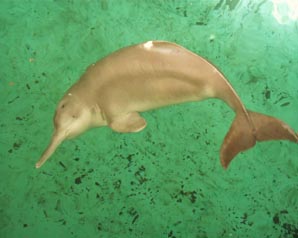

This is the Baiji, also called the Yangtze River Dolphin or Chinese River Dolphin. This dolphin is so well built for efficient living in fresh but murky river water it has survived almost unchanged for 25 million years. But, because of human impacts, fewer than 100 survive today, making this wonderful creature the most endangered cetacean species in the world. While Baiji give birth in April and May, after about 11 months of gestation, no one knows how many Baiji are being born into the dwindling population, but it's not enough. (Photo courtesy of the Institute of Hydrobiology, Chinese Academy of Sciences)

This is Qi Qi ("chee chee"), who was brought to the Wuhan Institute of Hydrobiology in 1980 after being injured by fishhooks. The combination of Qi Qi's individual ability to thrive in captivity and the care given by anxious Chinese scientists helped him to survive 22 years. He died in July 2002 at the age of 25. Much of what is known about the species, one of the world's four freshwater dolphin species, was learned from Qi Qi. As the impending extinction of his species became clear three female dolphins were captured over several years, to attempt a breeding program with Qi Qi. They all died quickly, apparently unable or unwilling to adapt to the stress of captivity. Efforts to make a "semi-natural reserve" or sanctuary in a river bow, where a few Baiji could be isolated and protected, failed because the remaining Baiji had grown far too wary to be captured. One that was caught and placed in the reserve died entangled in a net. (Photo courtesy of the Institute of Hydrobiology, Chinese Academy of Sciences)

The Pinta Island tortoise


QUITO—After decades of solitude, "Lonesome George" may finally save his species of Galapagos giant tortoise from extinction, his keepers said on Monday.

George, a Pinta island tortoise who has shown little interest in reproducing during 36 years in captivity, stunned his keepers by mating with one of his two female companions of a similar species of Galapagos tortoise.

Park rangers found a nest with several eggs in George's pen and placed three in incubators. It will take about four months to know whether the eggs bear George's offspring.

"Even if these three eggs are fertile and the born tortoises survive it will take several (genetic) generations to think of having a Pinta purebred ... even centuries," the park said in a statement.

After trying almost everything from artificial insemination to having George watch younger males mate, his keepers had nearly lost hope. At 60 to 90 years old, George is in his sexual prime and should be able to reproduce.

Scientists found a distant relative of George on another island last year, sparking hopes of another male for mating with some Pinta genes.

The visual differences of tortoises from different islands were among the features of the Galapagos that helped British naturalist Charles Darwin formulate his theory of evolution.

George, considered by many the world's rarest creature and a conservation icon, was thought to be the last of his kind after fishermen and pirates slaughtered his species for food.

Ecuador has declared the islands at risk and the United Nations says efforts to protect them should continue. Some 20,000 giant tortoises of various species now live on the islands.

The 90-year-old Pinta island tortoise is the last of his kind, and scientists have been coaxing the giant tortoise to mate with a similar species for 15 years – but, despite being in his sexual prime, George has shown little interest.

Last year, one of the many female giant tortoises to have tried their luck finally succeeded in seducing him. It was the first time George had succumbed in 36 years – but the resulting eggs turned out to be infertile.

Undeterred, his Galapagos Island handlers tried again this year. And on Monday, they found five eggs in his compound at the Charles Darwin research station on the island of Santa Cruz.


Last chance for world’s most endangered mammal


One of the Zoological Society of London (ZSL)’s key scientists, today unveils the plans for a crucial conservation project to save the world’s most endangered mammal, the Yangtze River dolphin. The dolphin, commonly known as the baiji, is the only living member of an entire family of aquatic mammals and is only distantly related to other dolphin species, but fewer than fifty individuals are believed to survive today. Writing in the journal Oryx, Dr Sam Turvey describes the measures that must now be undertaken if the world is to have any chance of saving this enchanting, but critically endangered animal.


The Yangtze River dolphin is only found in China’s Yangtze River system, and its numbers have plummeted over the past few decades as a result of severe habitat degradation, overfishing, collisions with boats, and construction of dams such as the Three Gorges Dam. As it is highly unlikely that conditions in the Yangtze will improve in the foreseeable future, plans have now been made to establish a closely monitored breeding population of dolphins in the Tian-e-Zhou National Baiji Reserve, a 21 km oxbow lake adjacent to the Yangtze in Hubei Province.

An Emergency Implementation Plan to initiate this crucial recovery programme has been developed by ZSL following a crisis meeting in San Diego attended by representatives from a range of Chinese and international organisations. The plan outlines how the few remaining dolphins can be captured and translocated to the Tian-e-Zhou National Baiji Reserve, and how a breeding population can be managed. This recovery programme will be managed by ZSL together with Chinese and international partners. ZSL is now seeking urgent funds to allow the dolphin recovery programme to be put into action. In this quarter’s Oryx, Dr Turvey, an expert in mammal extinction and conservation, describes these plans and calls for action. Dr Turvey stated “This really is the last chance that we have to save one of the world’s most evolutionarily distinct and unusual animals, which the Chinese government has described as a national treasure of the highest order. We have successfully developed an emergency recovery programme for the species, but it is essential that we now raise the funding necessary to implement the programme and act immediately. If we cannot do this, the baiji is certain to join the long and tragic list of species already driven to extinction by human activity. We have to act now if we want to save the species.”

Most Rare Animal in the World


Our nature has a rich biodiversity of fauna species, many of them are still exist in our world, and also many of them are extinct from our world.. and now worldmustbecrazy wanna take you to a tour to visit
World's most rare animal. this animal are threatened to extinction... let's preserve their species and keep them from their extinction... This is Most Rare Animal in the World

1. The Pinta Island tortoise
2. Baiji (Yangtze River Dolphin)
3. The Vancouver Island Marmot
4. Seychelles Sheath-tailed Bat
5. Javan Rhino
6. Hispid hare
7. Northern Hairy-nosed Wombat
8. Tamaraw (Dwarf Water Buffalo)
9. Iberian Lynx
10. Red Wolf


A closeup of the rare animal ‘caecilians’ discovered in Makaibari Tea Estate


A closeup of the rare animal ‘caecilians’ discovered in Makaibari Tea Estate
Photo by Himalaya Darpan

Spooky Animal


Tersier called "binatang hantu" which means "spooky animal" - Thise rare species is found on the island of Bohol in the philippines in asia. Look at his eyes - like in the movie "gremlins"

Sea Monster – underwater fossils and rare animal -& photogrpahy Technique


DISCLAIMER

The contents of this blog is taken from Internet only. Some images are from public websites, groups, Communities, discussion boards , e-mails etc.

We are extending our courtesy to those peoples,websites, groups and communities. If any suggestions or complaints, please Email me...